
Many of you are already aware of the Emerald ash borer and the threat all of our local ash trees are under here in Chapel Hill and surrounding areas. We get a lot of questions about this pest, signs of EAB damage to look out for, and what can be done to save your ash trees– here’s a brief overview.
What is Emerald Ash Borer (EAB)?
Emerald ash borer is an invasive beetle that kills ash trees– nearly 100% of them in parts of the US where it is present, and it is present here all over the Piedmont region of North Carolina. Many areas of the country have already seen the loss of 100% of their (untreated) ash trees. When EAB rips through an area, the only remaining ash trees are typically saplings too small to host the beetle’s eggs and hungry larvae, but once the trees grow large enough they get attacked too. Just the presence of this little green insect in your area is a death sentence for any untreated ash trees. It is not a matter of if your ash trees will be attacked and killed, it is only a matter of how soon. If you are lucky enough to still have healthy ash trees, we always recommend treating your ash trees before any signs of EAB damage. Preventative treatment has the highest efficacy rate.
So, first indication that it might be time to treat: you have an ash tree on your property (that you’d like to keep). More on identifying ash trees in our previous article about EAB.
For another great ash identification resource, check out this ash ID guide from the Perdue University Extension office.
What are the top signs of ash borer damage?
- Defoliation or thinning of canopy. Leaves look sparse, the canopy doesn’t seem as full or green as usual.
- Tip die-back. Tips of branches throughout the canopy are beginning to die, or maybe even larger branches are dead or dying (especially as infestation progresses).
STOP! These are typically the only signs of early infestation! If you don’t want to lose your ash tree, treatment should occur before 10-20% of your tree’s canopy is lost (the less damage the higher the success rate of treating to save the tree).
Later signs of EAB
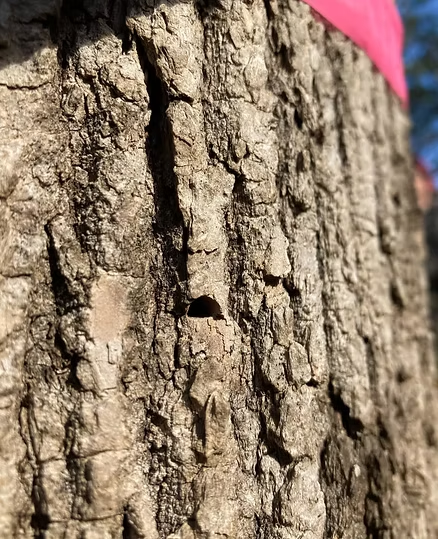
- Woodpecker holes along the trunk. Woodpeckers eat EAB larvae, so lots of woodpecker holes are a good indication that you’ve got a lot of beetle larvae already present and feeding on your tree. If you’ve got woodpecker holes paired with tip die back or thinning foliage, your tree’s chances of survival is decreasing.
- Very small D-shaped exit holes on the lower trunk where you can see them (at eye level). These are the holes made by adult borers’ flat heads as they emerge after a season of eating away at your tree’s vascular system as larvae. Once you can see these at eye level, and you’ve got significant canopy loss/ dieback, it is generally too late to save your ash trees.
What to do about Emerald ash borer (EAB) and your ash trees?
What to do with your ash trees is a personal question that homeowners must answer for themselves. If you’ve got ash trees that are already in decline that may not be worth attempting to treat, is it time to remove them? If you’ve got a tree that isn’t showing signs of infestation yet or has less than 10% canopy loss, does the benefit of keeping the tree and cost of ongoing treatment outweigh the loss and costs associated with removing the tree? Is the tree in a location that it won’t harm anything as it dies and falls apart in place if you choose to do nothing?
1. Remove trees that are high risk (urgent)!
Trees that are near your home, parking areas, children’s play areas, outdoor patio areas, etc, should be removed by a professional ASAP. Allowing these trees to continue to decline in place can make them increasingly more hazardous, not only for you and your family, but also for your arborist. The way that these pests damage the wood makes them especially dangerous as they decline. Once the trees are too far in decline to remove through standard felling or climbing practices, cost of removal will typically be much higher due to the added complexity and risks of the project.
2. Treat healthy (or early stage infestation) ash trees that you’d like to keep.
Ask an arborist who offers tree health care services (like us!) for treatment options and pricing. Treatment for larger ash is typically done by trunk injections and needs to be repeated once every 2-3 years, and smaller ash are usually treated with a soil drench insecticide application once every 1-2 years.
3. Decide to do nothing and enjoy remaining time with your ash trees.
If your ash trees are in an area where it is safe for them to fall apart where they stand, you can always just decide to let nature take its course and enjoy the trees for your remaining time with them!
If you need any help determining which stage of infestation you’re in or deciding what to do with your Chapel Hill ash trees, call an arborist.
If you’re interested in a little more history about Emerald ash borer in this area…
I first encountered the pest face-to-face in 2017 working in Durham and Orange counties. The early days were intense, watching the different EAB detection maps online, updating daily with new dots popping up all over the state until entire regions became big blobs of color– epidemic fully underway.
Driving through neighborhoods where 90% of the ash trees were already dead, trying to educate every client I met about EAB so they could have the opportunity to be involved in deciding the fate of their trees. I remember trying to create and distribute educational materials, leaving them in gardening centers and anywhere I could think of. No sales pitch, just free information about how and when to make educated decisions about ash trees.
In some neighborhoods, clients urged me to attempt to treat trees that already had 20, 30, 40% canopy loss, looking around at neighbors that had lost all of their mature ash. I offered discounted rates because we knew these treatments were experimental at best, and I was interested in having the data– how late is too late to treat an ash? Some (but certainly not all) of the trees at 20% canopy loss recovered, and miraculously at least a couple with closer to 40% canopy loss did. The best and most consistent results were in trees with no or very little apparent pest damage.
Over the years since then, we’ve walked hundreds of clients through deciding if their ash trees were worth treating (offering options for us to treat them or information for DIY treatment in appropriate scenarios) or if removal was necessary. We’ve seen countless ash trees too far in decline to save, with homeowners who simply had no idea until it was too late.
Please, even if you don’t have ash trees on your property, spread the word. Let people know so that they can make informed decisions about their property. We are always happy to chat trees, so please reach out if you have any tree related questions or concerns!
Where can I learn more about EAB?
Look for reliable information sources like university extension or government (Forest Service & USDA) sites and articles to learn more about what is going on with EAB and ash preservation efforts here in NC and throughout the country. Click here to see the NC State guide to spotting Emerald Ash Borer, and here if you want to find the answers to some frequently asked EAB questions on the NCDA&CS website!


